
Small teams buy steel office furniture for reasons that rarely appear in glossy catalogues: they need desks, lockers and filing that survive a move, a reconfiguration and a decade of daily use without a maintenance budget. With four to twenty people, every purchase decision is visible and every mistake is expensive per seat. This guide covers the choices that actually change the outcome — steel gauge, coating quality, storage ratios, footprint planning and supplier selection — so you can specify a set-up once and stop thinking about it.
Why Steel Is the Sensible Default for Teams Under Twenty
Steel furniture earns its place in small offices for structural reasons rather than aesthetic ones. A steel pedestal, locker or workbench holds its shape under load, resists impact from daily traffic, and can be relocated without the joint failure that plagues particleboard assemblies after the second move.
- Strength per unit of volume: a steel frame carries the same load as a much thicker timber section, which keeps desks and shelving compact in tight floor plates.
- Reconfiguration without loss: bolt-together steel systems can be dismantled, moved and rebuilt to a new layout, so a team that grows from six to twelve does not have to rebuy its storage.
- Cleaning and hygiene: powder-coated steel wipes down, does not absorb spills, and does not harbour dust in the way fabric-wrapped panels do.
- Fire behaviour: steel adds no fuel load to a room, which matters when a small office sits inside a larger tenanted building.
- Predictable lifecycle: a well-coated steel unit typically outlasts two or three sets of laminate furniture in the same role.
The trade-off is weight and, at the low end, resonance — thin-gauge steel panels drum and rattle. Most of this buying guide is about avoiding that low end.
Work Out Storage Demand Before You Choose Products
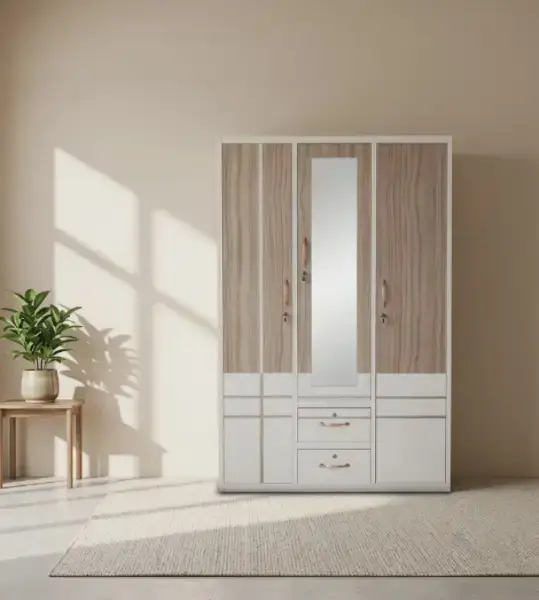
Small teams usually under-buy storage and over-buy desks. The sequence that works is to count what has to be stored, then size the furniture to it, then fit desks into whatever floor space remains.
Personal storage
Every full-time employee needs a lockable volume for a bag, a laptop, documents and personal items. A pedestal under the desk handles day-to-day use; a locker handles the coat, the gym bag and the backup items. For hybrid teams where desks are shared, lockers become the primary personal storage and should be sized one per person, not one per desk.
Shared and archive storage
Shared shelving, tambour cupboards and filing cabinets absorb the material that has no owner — samples, stationery, archived files, IT spares, event kit. A workable starting point for planning is to allocate roughly one linear metre of shelving per person for general office storage, then add dedicated filing capacity for any function that must retain paper records. If the team handles contracts, finance or compliance documents, treat that filing as a separate budget line rather than squeezing it into general shelving.
Room for growth
Buy storage for your headcount plus two. Lockers and shelving rarely cost less later, and an empty bay is a useful buffer during hiring cycles.
Specification Details That Decide How Long the Furniture Lasts
Two steel cabinets can look identical in a photograph and behave completely differently after three years. These are the points worth confirming in writing before you order.
- Steel gauge. Thicker sheet resists denting and holds door alignment. Ask for the gauge used on the carcass, not just the shelf, and confirm it for the doors separately.
- Welding and joint quality. Spot welds should be consistent and dressed; sharp weld spatter on the inside of a carcass is a sign of loose process control.
- Powder coating. A properly pre-treated, electrostatically applied powder coat is far more durable than wet paint. Ask about pre-treatment stages and coating thickness rather than colour alone.
- Edge treatment. Folded and hemmed edges prevent cuts and resist deformation. Exposed raw edges will rust first in humid climates.
- Lock and hinge hardware. Cam locks, three-point locking bars and full-length piano hinges are the difference between a cabinet that closes cleanly for ten years and one that sags after eighteen months.
- Levelling and mobility. Adjustable glides matter on uneven floors; castors make sense only where the unit is genuinely intended to move.
- Weight rating per shelf. Check the stated distributed load and whether shelves are fixed or adjustable on a defined pitch.
Steel Versus Laminate and MDF: A Working Comparison
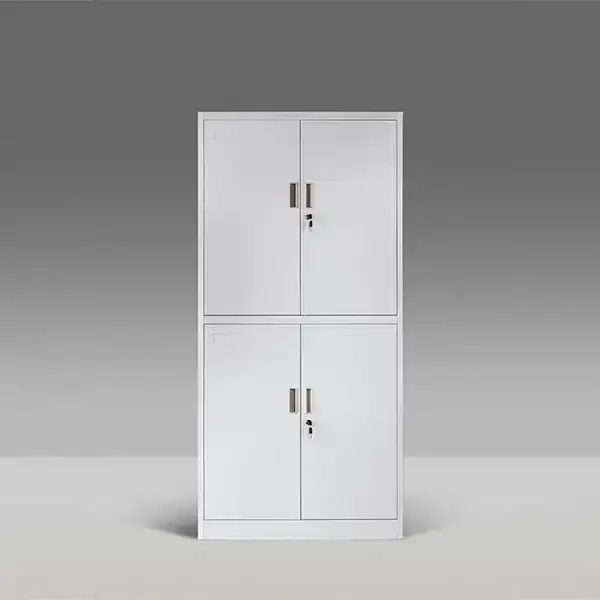
- Steel — advantages: highest durability, reconfigurable, space-efficient sections, easy to clean, strong resale or reuse value. Limitations: heavier, industrial appearance unless specified in softer finishes, noisier unless damped.
- Laminate on MDF — advantages: wide finish range, warmer look, low entry price, easy to match to a design scheme. Limitations: edge damage is permanent, moisture swells the core, joints loosen after repeated dismantling, shorter service life.
- Mixed specification — the pragmatic route: steel for storage, lockers, filing and frames; laminate or veneer for the visible desk surfaces. For most teams of five to twenty, this combination delivers the best cost-per-year result.
Space Planning Numbers Worth Checking Twice
Furniture that fits the budget but not the floor plate is the most common failure in small-office projects. Confirm the following before committing:
- Desk depth of 600–750 mm for task work; 1,200 mm minimum width for a single monitor set-up, 1,400–1,600 mm for dual screens and paperwork.
- Main circulation routes of 1,000–1,200 mm so two people can pass without turning sideways; secondary routes no narrower than 800 mm.
- Locker and shelving heights against wall runs rather than in the middle of the room, preserving open floor area.
- Clearance for drawer and door swing — a pedestal drawer pulled out needs roughly its own depth again behind the chair.
- Lift and door access. Steel units are heavy; check that what you order can reach the room.
Budgeting and Choosing a Supplier
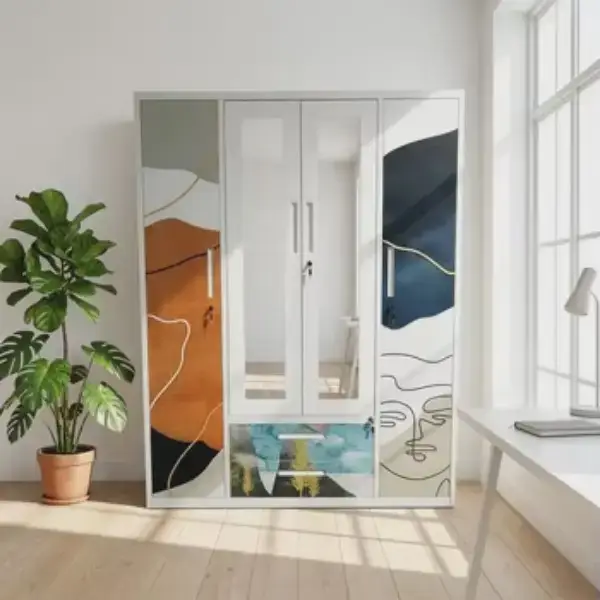
For a small team, the cost of steel furniture is split roughly between material thickness, coating and hardware, and the service you buy alongside it — delivery, assembly, warranty and replacement parts. Cutting the third element is a false economy when a single missing shelf clip can sideline a cabinet.
What to ask any supplier
- Exact steel gauge and coating specification, in writing, on the quotation.
- Load ratings and dimensions as delivered, not as drawn.
- Warranty terms covering coating adhesion, hardware and structural welds separately.
- Availability of spare parts — keys, locks, shelf clips, glides — two years from now.
- Lead time and delivery conditions, including whether offloading and assembly are included.
Manufacturers that serve both large contracts and small orders are often the better fit for teams of this size, because they can supply standard components quickly and adjust configurations without a full custom run. LAKSHYO, for example, produces modular steel storage and desking that can be specified in small quantities, which is exactly the profile a ten-person office needs: standard enough to be affordable, configurable enough to fit an awkward floor plate.
Frequently Asked Questions
How much steel office furniture does a team of ten actually need?
As a planning baseline: ten workstations or a smaller number of shared desks, ten personal lockers, one pedestal per desk in non-hybrid offices, plus roughly ten linear metres of shared shelving and dedicated filing for any regulated documents. Adjust upward for roles that handle physical samples or archives.
Is powder-coated steel furniture suitable for a client-facing office?
Yes. Modern powder coating is available in matte, textured and fine-structure finishes that read as furniture rather than as industrial equipment, particularly when steel storage is paired with timber or laminate work surfaces.
Should we buy mobile or static units?
Buy mobile only where the unit genuinely moves weekly. Castors raise the centre of gravity and reduce the load rating of tall cabinets, so lockers and tall shelving are better kept static with levelling glides.
What is the single most common specification mistake?
Specifying by photograph. Finish, gauge and hardware rarely show in an image, and those three factors determine service life more than any other variable.
Steel office furniture rewards a short, disciplined specification process: count what must be stored, confirm the gauge and coating, check the dimensions against real circulation widths, and buy from a supplier who will put those details in writing. Do that once and the furniture becomes a fixed asset rather than an ongoing expense.